The Secret Agents: Police Infiltration, Two Bombings, and a Clandestine Press Conference in 1976 Argentina
The Junta's plans had to account for the fact that many militants came from the same petit bourgeoisie and professional middle classes from which most serving military officers and civilian politicians had come from.

One of the most difficult things to explain about the Proceso is how in some respects it was not a dictatorship at all. Dictators, if we follow the original Roman model, are granted supreme individual authority to secure for the State unity of decision and speed of execution in its policies. Yet, after the overthrow of Isabel Perón in 1976, supreme power in Argentina was not decisively wielded by a single executive, but was split rather into three equal parts among the three heads of each of the Armed Forces, as was the formal machinery of state and even the public sphere (different services might assume control of different newspapers, or even create their own). Nor did power flow uninterrupted from the pinnacle of the Junta down to the smallest torture chamber, but was rather parceled out into an archipelago of repressive zones and sub-zones allocated to different commanders responding each to parallel chains of command joined together only tenuously at the top. The "Why" of this mechanism--what were the problems that the Junta was trying to solve by adopting such an almost pre-modern State structure– would take a separate post to explain.
March 24 of this year was the 50th anniversary of the 1976 coup by the Argentine military, which inaugurated the last and most notorious of a long sequence of Argentine military regimes in the 20th century. Much of what arguably still sets the Proceso de Reorganización Nacional apart from its peers in the Southern Cone --not least how little retrospective nostalgia it inspires among its natural constituencies among the political and economic elites in Argentina, something I wrote about in the post quoted from above– is directly traceable to important distinctions, or distinguishing characteristics, that have often become flattened out in latter writing, especially in the English-reading world.
Argentina is often subsumed into a larger regional story of imperfect civilian democracies overthrown, sometimes at the direct instigation of the US, by murderous military governments. Once in power, these regimes would wage, under the guise of counterinsurgency, what were in effect class wars against the left, trade unions, and any organization or popular movement it could convince itself was part of a Communist subversive effort. Economically, they would implement early versions of IMF adjustment packages: disfavoring local industry, weakening organized labor, dismantling developmentalist or protectionist obstacle to the free flow of foreign capital, and, to the extent possible, eliminating any economic role for the state beyond being a protector of investor property rights.
This basic story is, by and large, not untrue for Argentina. But the quantitative and qualitative uniqueness of this "Process of National Reorganization" can only be understood by looking at the specific problems--and enemies--that this peculiar regime had been configured to fight. Both the scale of its atrocities, and the unique degree to which the Proceso's leaders became independent of Argentina's own social and economic elites[[1]] are traceable to very deliberate decisions taken to ensure that this would not be "just another coup" [un golpe más].
Let us start with the decision to parcel out the entire state into an archipelago of repressive zones and sub-zones allocated to different units from the three armed services. To a limited degree this reflected an institutional concern that no armed service (or faction within an armed service) should acquire too predominant a share of political power, a source of factional strife and ultimate instability during previous military governments. But a much more important factor was an awareness that militant groups drew many of its members from the same professional middle classes that most serving military officers and civilian politicians had come from. If these militants were to be subjected to "Final Disposition" [disposición final, [[2]] ] it was critical that there be no obvious avenue of appeal by which families or friends within the military or civilian establishment would intercede for their survival, much less their release.
Let us now look at two examples, from the first months of the regime's existence, that illustrate why this aspect of their enemy was so very alarming for the Argentine Armed Forces.
Policy and Police
During the 1970s Argentine Federal Police was, unsurprisingly, a key element in the successive counterinsurgency campaigns waged by the "Revolución Argentina" dictatorships, the government first of Juan Perón and after his death Isabel Martínez de Perón, and finally that of the Junta that seized power on March 24, 1976. Slightly over 80 percent of Argentina's population was urban in 1975, and militant groups could not but reflect this. Outside of the attempt by the Ejercito Revolucionario del Pueblo (ERP, the straightforwardly Communist urban guerrilla group, as distinct from the left-Peronism of Montoneros) attempt to set up a rural guerrilla "foco" in Tucuman --which arguably became an ulcer on the organization as a whole--, cities and towns were the primary theater of insurgent and counter-insurgent action, where police forces were integral both to surveillance and repression. Policemen were also present in the right-wing death squads of the Triple-A (Alianza Anticomunista Argentina), set up by that spiritualist Rasputin of late Peronism, José Lopez Rega, to combat left-wing forces both within and without the Peronist Party. A key target was the left-wing Peronist group Montoneros, arguably the most powerful of the guerrilla forces active in Argentina when the coup took place. The Triple-A had been a first attempt to destroy them, and most of its members would be folded into the military-led "grupo de tareas" that took over the role of kidnapping and massacre after 24 March, 1976.
Under such conditions it is unsurprising the various police agencies suffered the brunt of losses to guerrilla action, with the total number of the dead from the Federal Police alone (119, losses to provincial forces were larger) actually exceeding those of the Army (105). While many of those killed were beat cops (indiscriminate targeting of policemen was a common point in Montonero self-criticism after the dictatorship), its senior leadership was not immune to these attacks. Alberto Villar, for example, had been brought back by Perón from retirement in 1974 to head the Federal Police , due precisely to his experience repressing left-wing and labor militancy during the dictatorships of the 1960s and 70s. Villar would play a key role in setting up the Triple-A, and was an enthusiastic and notorious repressor. He was killed in late 1974, when, in what appears to have been a collaboration between the ERP and Montoneros, a limpet mine was placed on his yacht in Tigre[[4]].
Several short-term appointments followed Villar, but on April 4, 1976, the newly-installed Junta chose General Cesareo Cardozo to lead the police. Cardozo was among the elite of his Military Academy class. He had graduated in the Infantry branch with a General Staff qualification, and had specialized in strategic planning, professional education, and had latterly been military liaison to Pinochet's Chile. He was a close collaborator of Jorge Rafael Videla, the Army head who would lead the first Junta, and Roberto Viola, another infantry General who functioned as Videla's political advisor. Cardozo wrote the deployment orders for the actual coup on March 24, 1976 on his own typewriter. His first job in the new government was liaison to the Interior Ministry, which, as in all Latin countries, oversees policing rather than public lands, before being appointed as head of the Federal Police on March 31.
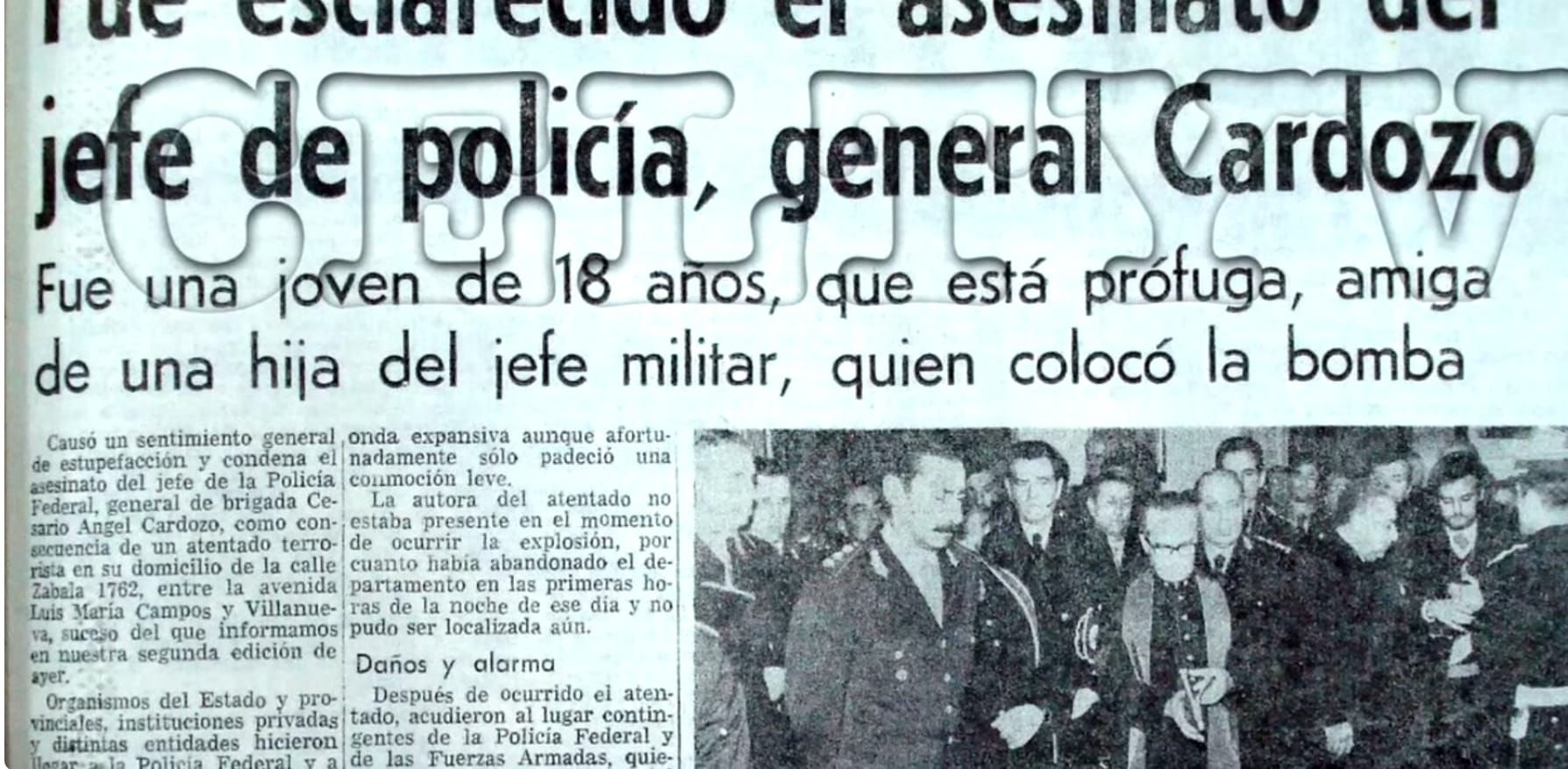
The police was already heavily involved in counterinsurgency and after the start of the coup it became even more important as the scale of illegal repression increased beyond anything seen during the previous government. Not much is known about Cardozo's actions leading this organization, and he would not have much time to make an impression. In the early morning of June 18, he was killed in his own house when a pipe-bomb exploded under his bed, his wife surviving with injuries only from having been being fortuitously in the bathroom when the device went off.
The Federal Police would sustain an even more serious attack two weeks later on July 2, with the explosion of a powerful bomb placed by Montoneros in the mess hall of the Coordinación Federal Building of Federal Police. This killed over 20 policement and injured over one hundred, and there were allegations that Army and Navy officers who were there for liaison purposes may have been among the casualties. This building had been, besides an active center of intelligence collection and agent-handling (the names of several civilian agents killed in the blast were not publicly announced for this reason), a "Centro Clandestino de Detención" since 1975. Under the direction of the afore-mentioned Villar, sections of it started being sealed off to detain and torture detainees who were not put in the records, and were usually killed afterwards. (The term of art for this was that they were "in condition RAF", for the Royal Air Force, i.e. "in the air.") The bomb's damage did not majorly affect any of the areas being used for these purposes, but the entire building had been heavily guarded, the fact that a guerrilla organization could smuggle a bomb into it was as shocking as being able to place a bomb underneath a General's own bed.
It became known very quickly, and reported in the press, that both attacks had been carried out by members of Montoneros who had been able to infiltrate themselves into these spaces. The bomb underneath Cardozo's bed was brought there by Ana Maria González, a 20-year old student-teacher who had befriended the General's daughter. The bomb in the dining hall, by Jose Maria "Pepe" Salgado, a 22-year old who had performed his military service in the Federal Police and, after his discharge, had been retained as an police non-commissioned officer in the Communications. Let us take a closer look at how Montoneros was able to achieve this.
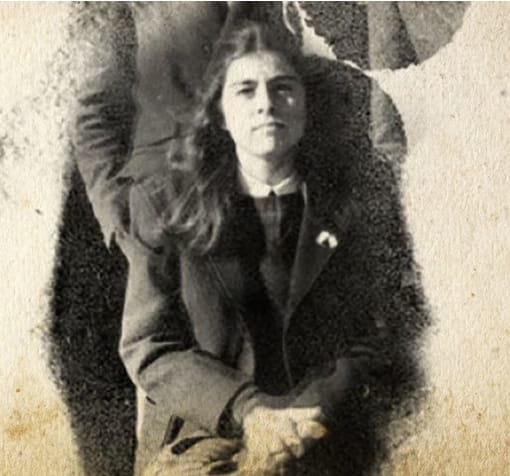
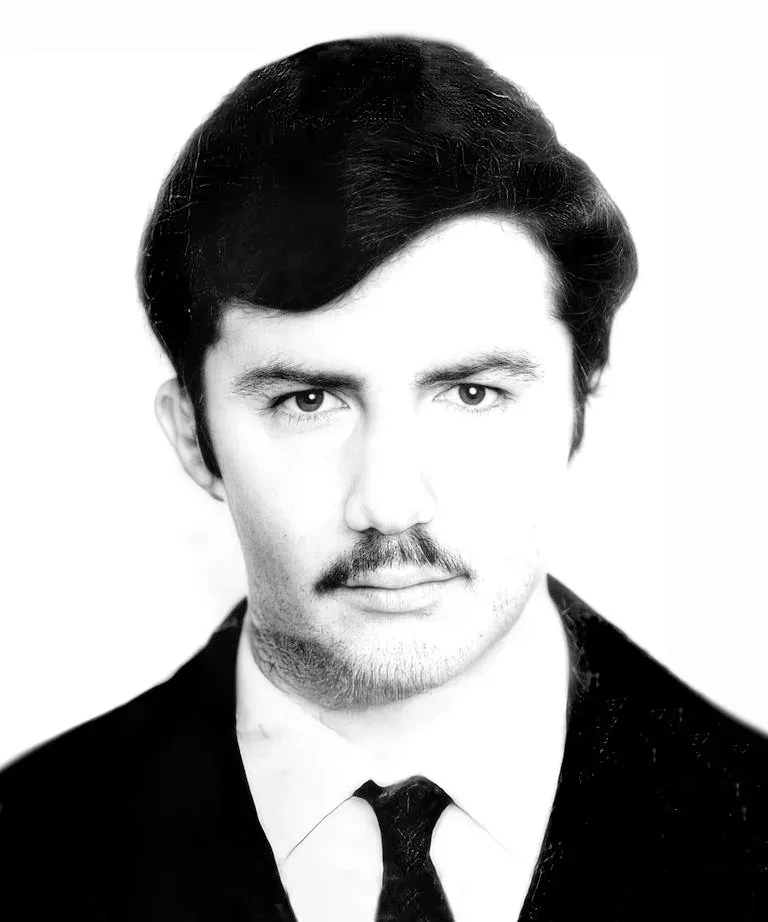
Left: School photo of Ana Maria Gonzalez, who would place the bomb underneath the bed of General Cardozo. Right: Juan "Pepe" Salgado, who, as a civilian agent of the Federal Police, would introduce a bomb into the dining hall of the Coordinación Federal Building.
Organizational Capacity
"Class traitors" are of course nothing very unusual in times of political ferment, but what is striking about these two militants is, in retrospect, is the organizational, even bureaucratic quality of the process by which they came to play their roles. Given how often the Argentine insurgent organizations are grouped with European "urban guerrillas", it should be stressed that the former were significantly larger than, say, the tens of members and hundreds of sympathizers of the various generations of the Red Army Faction or "Baader-Meinhoff group" in Germany. As with most numbers having to do with the Argentine dictatorship, the total figure for the number of active members of guerrilla groups, as well as that of people who could be considered sympathizers, is a deeply controversial subject. But, to focus now on Montoneros as the organization that carried out both attacks, most estimates put the number of its active members above one thousand, to which one should add some multiple of 1 or above for its sympathizers. This is important because the attack against Cardozo came about due to the scope and effectiveness of their internal party organization.
Many young people had joined Juventud Peronista organizations after Perón's return in 1973. The principal "civilian" organization for Montoneros-aligned was the Peronist Youth (Juventud Peronista or JP). Its militants were organized into "Basic Units" (Unidades Básicas), more or less equivalent to the local chapters of a political party. Their regional deployment was very extensive, from units working in the many Buenos Aires shanty-towns to others near residential upper-middle class neighborhoods.
Ana Maria González belonged to one that straddled both. The Unidad Básica "Ramon Cesaris" (named after a JP militant killed by a police gas grenade during a demonstration) was located within the prosperous residential area of Beccar, but it very close as well to the shanty town of Villa Cava. She attended the teaching college number 10, "Juan Bautista Alberdi". Gonzalez's parents were solidly of the professional middle-class, her father a surgeon and her mother a psychologist. Her work at the Unidad Básica included tutoring grade-school age children in a working class neighborhood.
The April 1976 issue of the official Montoneros publication, Evita Montonera included a two-page piece called "The Eyes and Ears of the People", written as a "Letter from the Montonero Information Service to all Comrades in the Movement" (page 26-27 here).
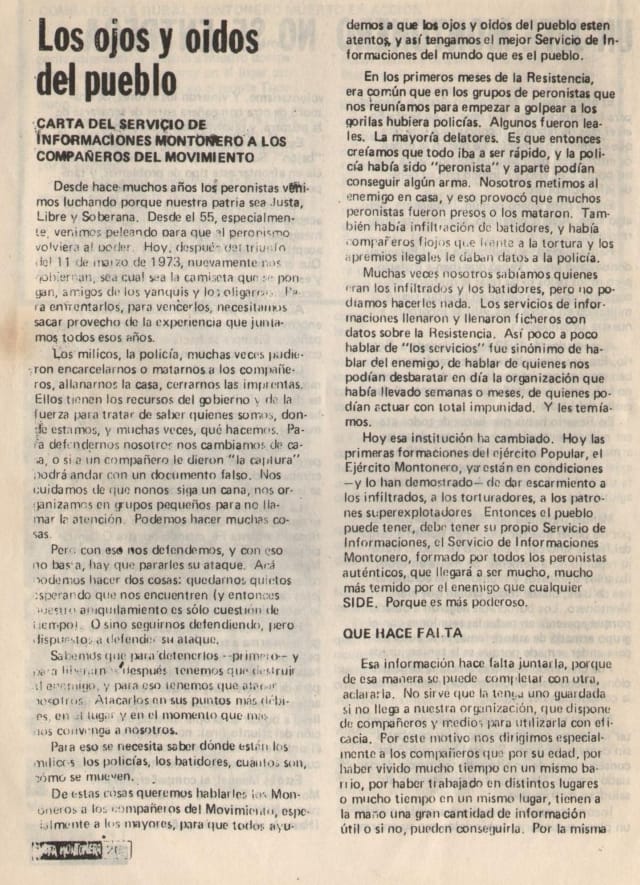
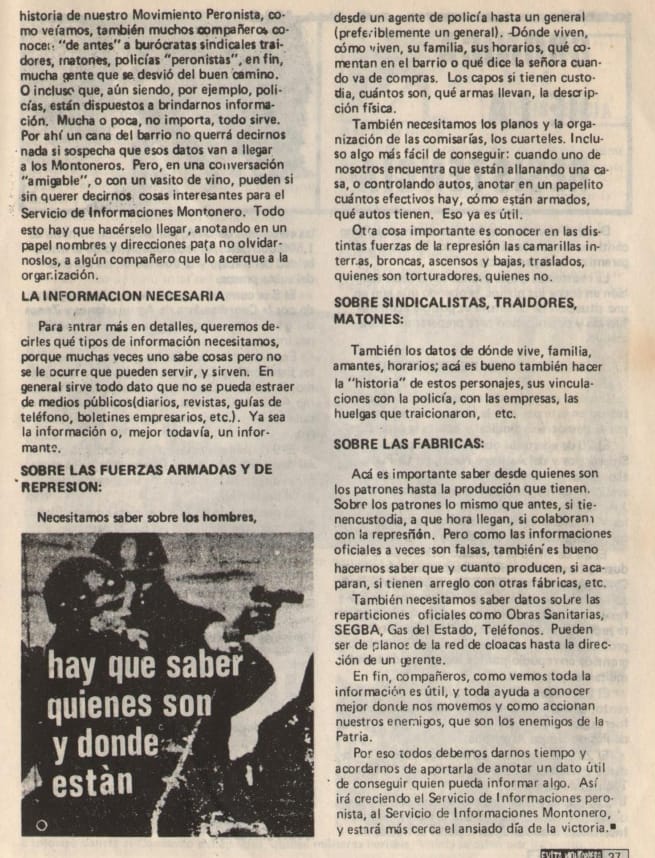
"The Eyes and Ears of the People": Article in issue 13 of the official Montoneros publication, Evita Montonera (pp 26-27). After this article came out Ana Maria Gonzalez reported to her superiors in the organization that she went to the same class as the daughter of the newly-named head of the Federal Police, General Cardozo. In the second photo, the headline superimposed on the photo reads, "We Have to Know Who They Are and Where They Live"
WE NEED TO KNOW WHO THEY ARE AND WHERE THEY LIVE
We need to know about the men, from a beat cop to a General (but preferably a general. Where they live, how they live, their families, their routines, what do they say in their neighborhood about them, what does the wife comment when she goes shopping. If they have bodyguards, how many, how are they armed, what do they look like.
We also need floor plans and organization charts for police stations and military bases. Or even just, when we observe them at a checkpoint or when they are conducting a search of a building, just write down on a piece of paper how many are taking part, how are they armed, what are their vehicles. This is all useful.
Ana María González would describe how, when the newspapers announced that Cardozo had been appointed as head of the Federal Police on March 31, she
[G]ot in touch with my superiors [in Montoneros] and informed them that I attended the same school as María Graciela, daughter of the chief of the Federal Police, General Cesáreo Cardozo. We then decided that I should try to establish a friendly relationship so that I could be invited to her family's house. It was difficult at first, above all because our relationship during the first schoolyear had been hostile, as our differing political positions led us to fight with each other. This is when we [the Montonero planning group] realized that under such circumstances it would be very difficult to gain access to her house, the most we would be able to hope for is stopping by to ask for school notes.
So during the first week of class González strove to establish a connection with the daughter of Cardozo by
[M]aking up a story about my being emotionally fragile and needing the support of my schoolmates. I joined the the study group María Graciela had with two other officer daughters. Two weeks in I was visiting their house regularly and established a pretty close connection to the family. I would often call Maria Graciela to tell her, "Look, I'm having a rough time now and I need to speak to someone. I'm on my way to your house."
María Graciela, who last year gave her first public interview on this subject, recalled the same change between the first and second year of class. Ana María approached her circle of friends, telling them that her boyfriend had left her while she had been ill with hepatitis, and she was feeling lonely. María Graciela and her friends felt sorry for her, and allowed her to join their study group.
The militant who placed a bomb in the Federal Police dining hall was, if anything, an even more alarming case from the point of view of the military leadership. Because Jose Salgado didn't just know a senior officer's family member, he was himself the nephew of a senior officer, General Enrique Salgado, commander of the Army's III Corps.
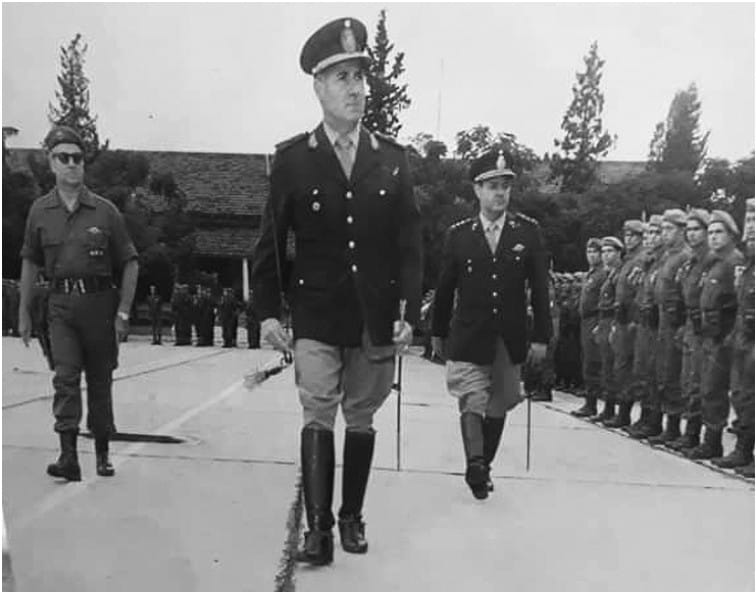
This was one of the most important area commands after Buenos Aires, as it included (map) the provinces both of Córdoba, the capital of which was seen by many officers as a nest of subversives ever since the 1969 Cordobazo popular uprising and the ones that followed, and Tucumán, where since 1974 the ERP guerrillas had been setting up a rural guerrilla foco on the eastern foothills of the Aconquija (very roughly in this area). Salgado had began to make preparations to take action against the latter, as over the course of the year federal police forces sent to the area had been unable to dismantle the ERP's bases. It was during a flight to reconnoiter the terrain by air that Salgado and a good number of his senior subordinates perished in a crash (almost certainly accidental), which would delay the start of the counter-guerrilla "Operativo Independencia" for a few months. Pepe Salgado actually expressed happiness about his death during a family dinner, his older brother Jorge would recall, who was very surprised, as nephew and uncle had earlier been very close.

"Pepe" Salgado appears to have become a Montonero supporter at some point in 1974, while studying engineering in Buenos Aires University. To a degree he followed in the footsteps of his elder brother, Jorge, who had joined the Juventud Peronista as an engineering student, but became far more committed to the more radical factions within it. Jorge would later recall that "I joined I think partly to find out what Peronism was about."
I met many Peronists who were not in the Revolutionary Tendency or in Montoneros, who were more moderate. I went to talks, I did political activism. But I started stepping back in 1974, when I saw that things were going in the direction of a very dangerous violence. But Pepe continued, with increasing fanaticism.
He blamed Pepe's girlfriend for this.
I knew her when I was in the college. She was active in Tendencia Revolucionaria. In 1972 there were a lot of students like her, who went to university not to study but to do political activism. She was much older than [Pepe], at least five years older.
But if his girlfriend was apparently instrumental to Salgado entering Montoneros, the path that would take him to that dining hall in the Coordinación Federal building was set, as it happens, by one of the greatest literary and political figures of the era, the writer and, in mid 1974, Montonero officer Rodolfo Walsh . Pepe attended a talk that Walsh gave in the student union of the Engineering College of the Universidad de Buenos Aires. It appears that shortly afterwards he began working directly under Walsh, in an intelligence unit he ran within the Montoneros organization [[5]]. Walsh had been collecting information and cultivating sources within the Buenos Aires police forces ever since his 1957 classic Operación Masacre. His ability to run what was essentially an homemade intelligence service was extraordinary, and both his knowledge and files became available to Montoneros when he joined the organization in 1973 coming from the Fuerzas Armadas Peronistas (FAP), a different group within left-wing militant Peronism.
Salgado's encounter with Walsh was opportune, as it happened just before he was due to be called up for military service. This is important because we know that he used his family's connections to have himself assigned to the Federal Police. Military service here was highly coveted, as, after a two-month period of basic training, it was essentially an office job in Buenos Aires that allowed one to sleep in one's home. Salgado's father's best friend was a senior officer in the police, Commissioner Alberto Torres, with the two families living only a few blocks from one another. He had already done this favor for Salgado's older brother in 1969, and he was glad to repeat the favor in 1974.
As Salgado's conscript term of service was coming to an end, he asked Commissioner Torres whether he could arrange to be kept on in the Federal Police. The latter thought this odd, but Salgado explained that he wanted to make some money while working a job that allowed him to continue studying at the nearby Engineering College. He would remain employed by the police until he requested to be discharged on July 1, one day before he would bring that bomb into the mess hall of the Coordinación Federal building.
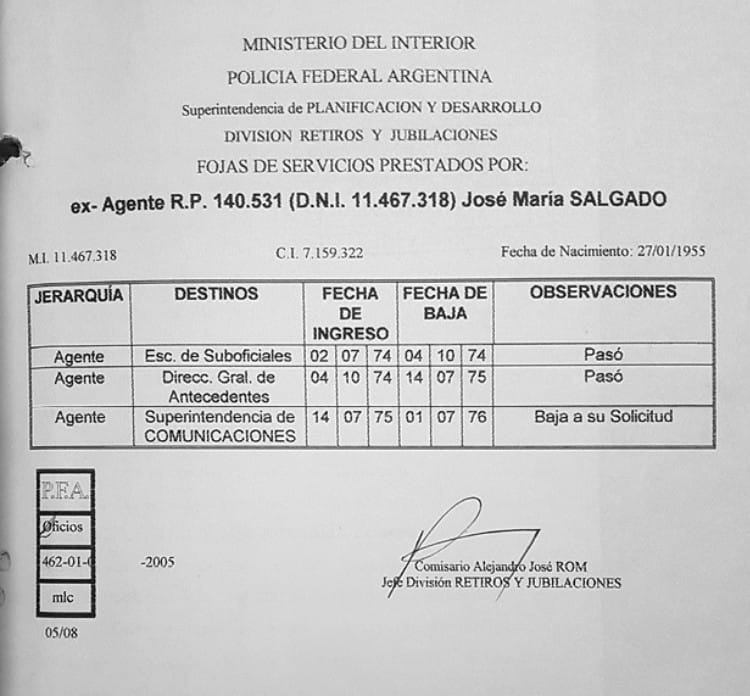
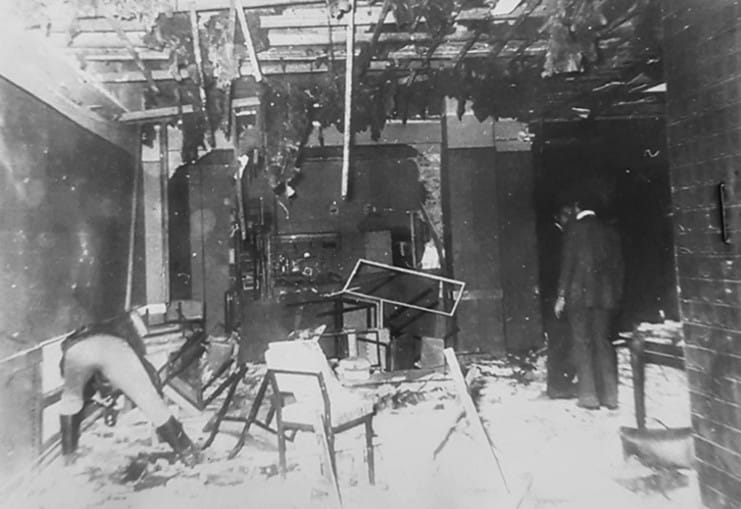
Left: Pepe Salgado's service record in the Federal Police. After a two-month period of basic training in the NCO school, he joins the Records department (Direccón General de Solicitudes) October 4, 1974, remaining there until July 14, 1975, when, with a family friend´s help, he was taken on as an agent in the Communications department. Note that his date of Discharge, July 1, was one day before the bomb attack. Right: Mess hall in the aftermath of the attack.
There is much more that could be said about these attacks, not to mention the fates of its authors, but I am here concerned narrowly with giving a sense of the organizational capacities and social extent of the Argentine insurgent groups. We have seen their recruitment mechanisms in action. Let us now take a look at their public relations.
A Clandestine Press Conference
A few weeks after what Montoneros had dubbed "Operación Cardozo", a correspondent for Spanish magazine called Cambio16, Francisco Cevecedo, attended a kind of clandestine press conference held in an event space that, it would later transpire, had been seized by Montoneros for the occasion. After following some Cold War spy novel instructions ("tomorrow, at twelve-noon exactly, be at the intersection of Junín and Córdoba streets and wait at a bus stop. You will be approached by someone wearing a watch on their right wrist and a copy of the magazine Siete Días. He will ask you the time and you . . .¨), this journalist came into "an event space usually rented for weddings, baptisms and first communions", located just two blocks from two separate police stations, with an army base less than a mile away.
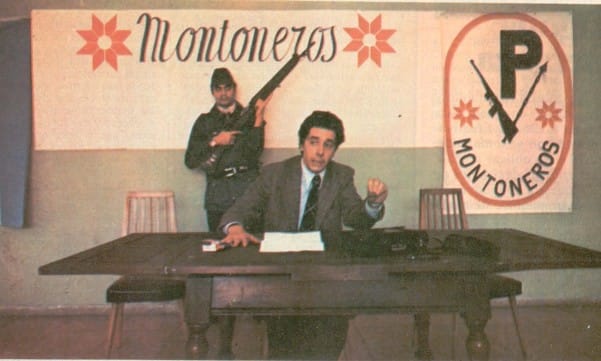
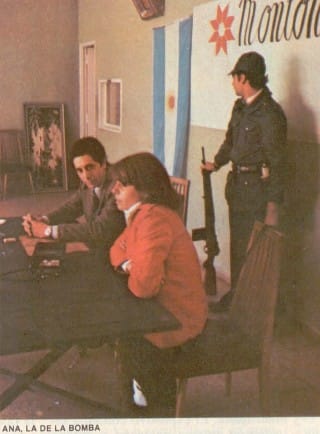
Left: Horacio Mendizábal, unknown militant in uniform. Right: Mendizabal next to Ana María Gonzalez.
The interview[[6]] would be conducted in slightly surreal circumstances, with both hors d'oeuvres and improvised explosive devices being laid out on tables and large Montonero flags along the walls. González was accompanied by Horacio Mendizábal, Military Secretary of Montoneros and a member of its leadership group. While they were dressed smartly as for a semi-formal occasion, there were other Montoneros who had put on the movement's own improvised military uniform. The journalist would discover later the normal staff had been confined to the kitchen under guard, and any visitors who looked in while this press event was happening were seized and taken there until its end.
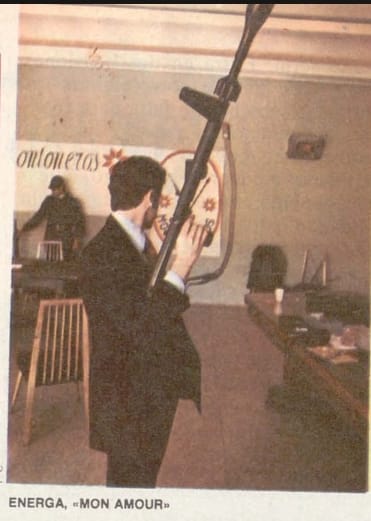
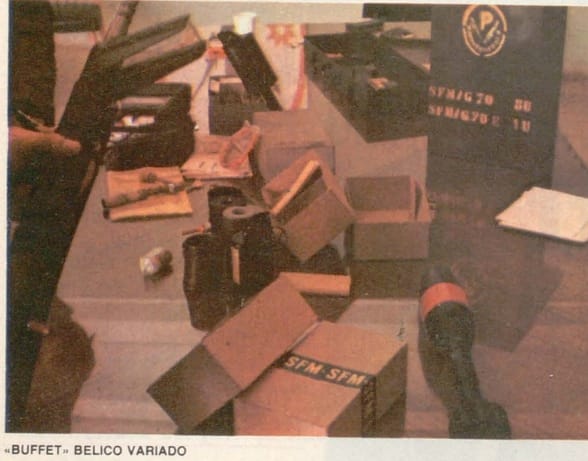
Left: Mendizábal holding an "Energa" grenade launcher of Montonero manufacture. Right: Other homemade weapons manufactured by clandestine Montonero workshops.
During the press conference, Ana María revealed that, while she had been successful in befriending Cardozo's daughter and gaining access to her house, the entire operation came close to unraveling in June, when she was picked up by the police with some comrades when on her way to a Montonero meeting.
I told the police at once that I was a friend of María Graciela Cardozo and of all my other classmates at school. I was counting on the fact that [María Graciela's] number was in my organizer, if this hadn't been the case my situation would have been much more complicated. At first they dismissed what I was saying, but after their torture sessions and investigations didn't find anything compromising, their attitude changed entirely and they started treating me very considerately, very sweetly and buying me chocolates . . . When I was freed I called Maria Graciela at once. I told her what had happened in very general terms, and then there was a slight distancing, very probably due to her family being on a high alert.
This coolness persisted for a few days, but González was eventually able to resume her visits to the general's house. According to Cardozo's daughter, María Graciela, she had been released by the direct intervention of her father. María Graciela was incredulous when Cardozo told her that Ana María was in Montoneros. He advised her (and her other friends, also officers' daughters) not to change their attitude towards her, hoping, her daughter says, that Ana María would reconsider.
This, of course, did not happen. González would describe during the press event that after two visits "we had gathered all the information we needed to carry out the operation."
Until then we did not really know where we could place the explosive. We knew we wanted to place it underneath his bed, as we could count that at some point Cardozo would be there, but we didn't know what excuse I could use to go into the master bedroom. When I found out there was a second telephone in the bedroom we had all we needed.
The guerrilla organization set Thursday, June 16 as the day to carry out the attack.
That day I went to school with the explosive [a pipe bomb] in my purse. As usual, María Graciela's bodyguards picked us all up and we went to her house in a Ford Falcon with siren blaring and the guards' machine guns sticking out of the windows . . . [Once in the house], I waited for a time before [Cardozo] or his wife would be coming back. At 6:40PM I asked for permission to go to the bathroom. I went there, activated the pipe bomb [caño] , placed it under the bed, and started to leave, before realizing that I had probably placed it at too low a height. I went back and moved it so that it was near the headrest. I then came back to María Graciela and told her that I was feeling ill and I would go home. We finished a few drawing, I asked the other girls to bring them to me some other day, and I left.
Asked about her feelings about befriending a family in order to kill the father, Ana María González was implacable.
It fell to me to undergo one of the worst sacrifices a militant can experience: living alongside a hated enemy. For a month and a half I had to frequent Cardozo's house while he was directing the kidnapping, torture, and murder of tens of my comrades. I had to sit at his dinner table and endure his smile and jokes whenever there was news that [a militant] had been killed.
What was Cardozo like at home? Ana María González explains that she didn't have many opportunities to talk to him, but eventually "we would develop a very good relationship; he really liked me, would gift me theater tickets . . . But he was often not at home, and when he was in he would simply watch television or sleep."
On the day following the explosion, the police came to Ana María's apartment, which was empty, her parents having left the building in advance. A few hours later, the whole floor was blown up by an explosion.
I had told my family, on the day of the operation, that it was very likely that the police would be conducting a search of the house because they had seized some compromising papers that included my name. I told them that, given how this government treated the families of militants, that the best thing they could do would be to go to a relative's house, at least for that night, that in the morning I would have a better idea of where I stood. My group got in touch with them, but they had already heard the news. After this I had no further contact with them, although I know, through another source, that they are all right.
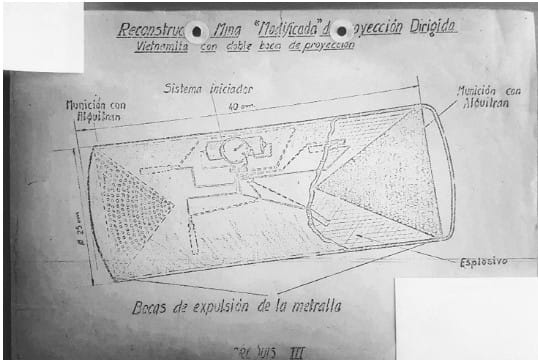
Horacio Mendizábal now took over the press conference, discussing the device used in the attack. "It had a dual timer that we estimated would detonate around one-thirty in the morning. The explosive had seventy grams of trotyl and was packed in a box of "Crandall" perfume, disguised as a Father's Day present."
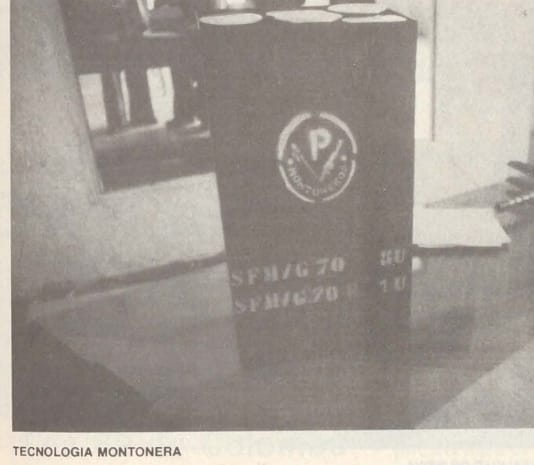
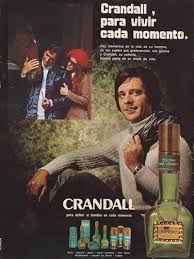
Left: Montonero pipe-bomb devices on display during the press event. The charge was usually wrapped in a container full of ball bearings and nails, this sort of device was known at the time as a "Vietnamese bomb" [bomba a la vietnamita] Right: González had smuggled the device she used within a box of "Crandall" cologne she claimed she´d bought as a Father´s Day present.
Mendizábal expressed surprise that official communiques reports had initially pointed to ERP as having carried out the attack. "They knew that we had done it. Ana María had a police record as one of our militants." Another Montonero at this event suggested that "It is more convenient to blame ERP for Cardozo's death because they use a lot of internationalist symbols, they can be accused of being Marxists following orders from outside the country. We, on the other hand, have no known links to the Soviet Union, we're just 'the boys' [los muchachos], we're very much part of the local scene."
The political purpose of Cardozo's death was very clear to González:
We talked about this quite a bit, especially in those last few days after I had been arrested, when it seemed that things would get complicated. We viewed this kind of operation as very important to reinforce the morale of our guerrilla comrades. We had been suffering many losses at this time, and while our own military actions were happening and were effective, press censorship meant that there wasn't a lot of news about them. With an operation like this one there wouldn't be propaganda problems, as such a death could not be kept from public opinion. And the objective to eliminate the head of the [Federal] police needs no elaboration.
Horacio Mendizábal added:
I would like to add an important element. Our compañera here [González] is a soldier in our organization and what she is describing is testament to the high morale of our forces. She was willing to go back to Cardozo's house even after having been picked up and tortured by the police fifteen days earlier. This is proof not just of cool nerves but of a very solid ideological determination, as, during discussions after her arrest, it was she who insisted that she was determined to follow through with this operation.
This operation shows how in a popular war the enemy has no safe rear areas. They attack our neighborhoods, our militants, but we can also strike lasting blows against their own centers of gravity. This is not however a central part of our strategy, which operates along other lines. The enemy is misrepresenting our doctrine about the use of explosives. We never use bombs indiscriminately, they are always targeted.
Medizabal then turned to the attack on the Federal Police building. The device used then was of similar design to the one used in the "Cardozo operation", but markedly larger, with nine kilograms of trotyl and five of ball bearings detonated by a timer.
A compañero [Pepe Salgado]we had infiltrated had been coming into the building bringing in a harmless package for a week beforehand, as a test. After we saw that this would present no problems, we decided to execute this operation, which also shows the coolness and high morale of our fighters, as the compañero had been calmly having lunch at the mess hall, leaving with just seven minutes to spare after setting the timer. At this mess hall everyone referred to each other by pseudonyms, you would never hear an actual last name there, everyone was wearing dark glasses: it was an extremely clandestine space.
Mendizábal described his organization as carrying out "a strategic defensive", with a policy of "harassing the regime at all points." But this was only a preparatory phase. Eventually there would be a counteroffensive by a "Montonero Army" (Ejército Montonero), that would be ready to lead mass resistance once local insurrections had precipitated an economic crisis for the regime.
A final note of interest during this press conference were Mendizábal's remarks distancing Montoneros from a strict allegiance to Peronism.
Peronist ideology is one thing, but this is not the same thing as Peronism as the identity of the Argentine working class. We are clearly socialists and want the Montonero movement to build socialism in Argentina, something Perón would never allow.
"Something in the Air"?
I hope that by now the reader will see that the Argentine urban guerrillas represented more than the small cells of Western European militants that are usually associated with the term. We have also seen the degree of ideological and personal commitment of its militants. In the 90s and especially the 2000s it was easy to dismiss the attitudes of these militants as an inexplicable and ultimately fatal radical nihilism.
I do not think this framework is adequate to understand an organization of this scale, nor to account for why so many people from so many different backgrounds were willing to participate in it. If the course of action these groups took was ultimately suicidal, as indeed many former militants would themselves acknowledge after the return of democracy, it becomes all the more important, or anyway interesting as a historical matter, to grasp why it seemed to them eminently practical rather than utopian. Was there a rational, or at least practical, reason to believe that a militarized political organization could lead a successful popular revolution?
I will argue that this case can be made, for two reasons. The less surprising one is the simple chronological context in which these events were happening in the early seventies: with the US Army retreating in disarray from Vietnam, defeated in part by the rural-urban guerrilla force of the Vietcong, the overthrow of the Salazar regime in Portugal, the increasing isolation of apartheid regimes facing Communist insurgencies in Africa.
So far, so reasonably well-known, at least among people interested in this period. The second factor, however, will probably be less familiar, especially to those accustomed to seeing the Argentine story as essentially the same as those of Chile and Uruguay. Because a strictly factual case can be be made that urban guerrilla forces in Argentina, unlike their peers in Chile or Uruguay, had fought and defeated a repressive military government. Their strategies going into the fatal year of 1976 have to be understood as in part a kind of "victory disease", a confidence in future victory born from an earlier triumph. This will be the subject of an upcoming post.
[[1]]: So much so that in April 1982 that they seriously sought an alliance with Cuba and the USSR in order to rescue themselves from the war they had launched against Great Britain, a NATO ally. Nicanor Costa Mendez, the Junta's Foreign Minister, actually flew to Havana, met with Fidel Castro, and finalized a trade deal.

[[2]]: It is a minor English-language misconception to believe that the 1968 Paris student events played any significant role at all in their political thinking, much less their military plans.
[[3]]: A term used internally to denote when detainees, after all usable information had been extracted, were killed and their bodies secretly disposed of.
[[4]]: This attack would have a very odd sequel. The bomb was placed by Máximo Fernando Nicoletti, who had trained as a tactical frogman ("buzo tactico", or underwater demolitions) in the Navy and later joined Montoneros. He would later lead a commando that severely damaged the Navy destroyer Santisima Trinidad while it was still under construction. Captured by the Navy, he would save his life by becoming a cooperator. In 1982, after it was clear that the UK would send a naval task force to recover the Falkland Islands, he would be ordered to infiltrate Gibraltar in order to attack Royal Navy vessels in port. This "Operation Algeciras" failed when his team was arrested by the Spanish police. (There is a very interesting Argentine documentary about it here.) Nicoletti would later become a professional bank robber.
[[5]]: The role of Rodolfo Walsh in Montoneros is much too large a subject to address in passing. The English wikipedia article linked to in the main text is spotty and may at times be gnomic for people unfamiliar with the period. It could be preferable to web-translate the corresponding article in Spanish wikipedia.
[[6]]: Accessible in full here, on page 40.